
Searching the Wichita County Court Docket
Wichita County runs one online hub for its court docket: the Wichita County Odyssey Portal. The dashboard splits the work three ways. Smart Search finds a case. Search Hearings checks the calendar. Make Payments handles a payable item once you know the right court. Remember the limits. A payment screen is not a full docket. A hearing result is not a certified record.
Before you type anything into a docket search, gather the full case number, the party's filed name, a rough year, and the likely court. Try the exact number first. Names get shared, misspelled, or entered in different formats, so a number beats a guess every time. Once results appear, match the court, filing date, case type, and caption before you trust what you see.
- Read the summons, citation, order, or notice and identify the named court.
- Choose Smart Search for a case or Search Hearings for a future date.
- Enter the complete case number; if unknown, try the filed name and a narrow year range.
- Confirm that the court and case type match.
- Read entries chronologically, giving the newest setting or order priority.
- Contact the correct clerk if the result is missing, incomplete, or needed in certified form.
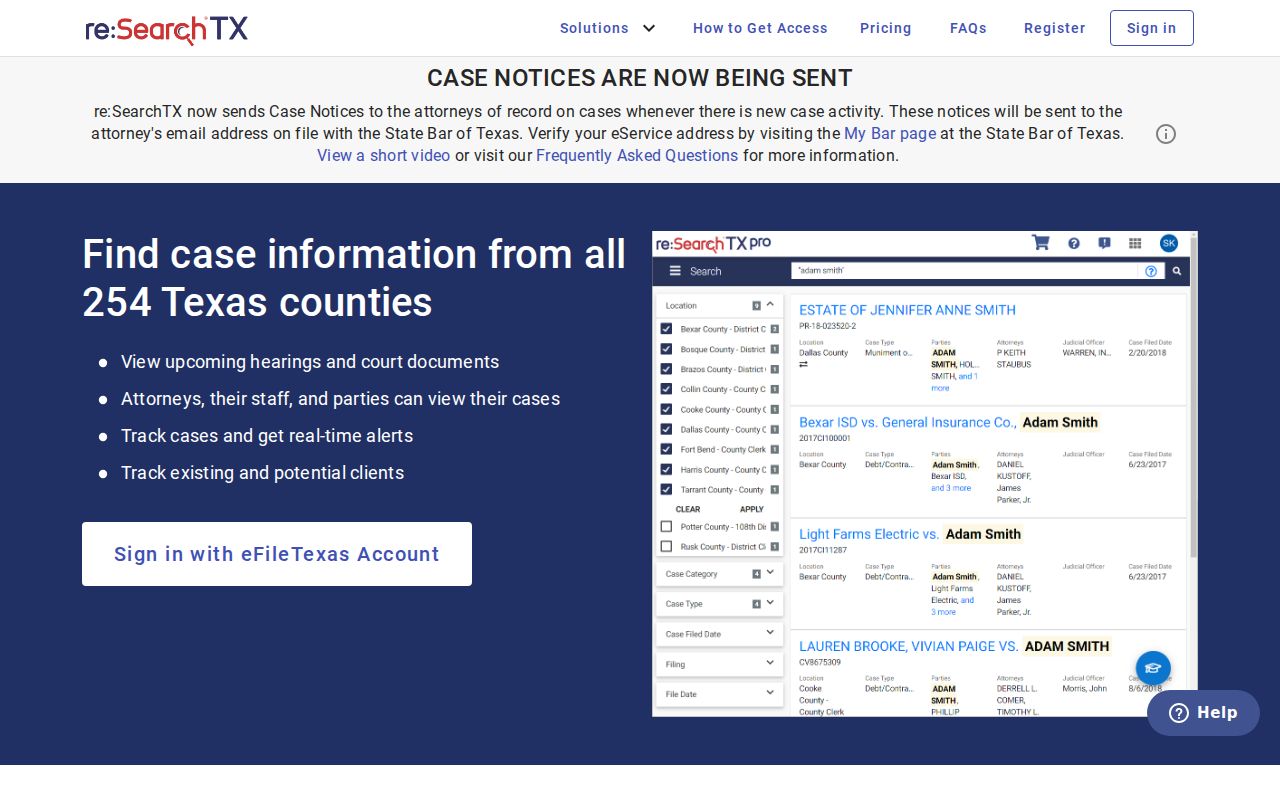
Need civil coverage beyond the county? re:SearchTX adds a statewide layer through its document collection. One catch matters for criminal cases: state reporting says those records stay out of the collection, so the county felony route still applies. For registered users, documents run ten cents per page under the applicable fee order, with a one-dollar minimum per document.
Wichita County Uses Two Clerk Offices
Two clerks, two jobs. The District Clerk holds felony criminal, district civil, family, juvenile, and delinquent-tax records. Holdings reach back to 1882. The County Clerk keeps the County Court at Law side. That side covers misdemeanors, probate, guardianship, and mental-health matters. Both offices share the same courthouse. Even so, a request sent to the wrong counter will stall the search.
| Case type | Likely custodian | Starting route |
|---|---|---|
| Felony, divorce, district civil or family | District Clerk | County portal, then Room 108 |
| County misdemeanor, probate or mental health | County Clerk | County portal or Room 250 |
| Eviction, small claim, debt or JP traffic | Named Justice Court | Precinct office |
| City ordinance or municipal traffic ticket | Named Municipal Court | City court |
Both main counters sit at 900 7th Street, Wichita Falls, Texas 76301. The District Clerk is in Room 108. That office answers 940-766-8100, option 5. The County Clerk works from Room 250 at the same number, option 1. Public hours run Monday through Friday, 8:00 a.m. to 5:00 p.m.
Inside a Wichita County Court Docket
Think of a court docket as a chronological index. It is not a story. The header alone tells you plenty. Case number, court, filing date, case type, caption, and status. Dated entries below it track pleadings, notices, motions, hearings, orders, pleas, judgments, resets, and post-judgment activity. Each setting may list a date, time, courtroom, judge, and event type. Financial sections can show public fines, costs, fees, or balances.
| Case number | The court identifier; an official felony index uses examples such as DC30-CR2025-0834. |
|---|---|
| Filed | The date the clerk received or opened the case. |
| Setting | An event such as arraignment, pretrial, motion hearing, docket call, plea, or trial. |
| Entry | A dated filing or court action; its document may require a separate request. |
| Status | An administrative label, not necessarily the final legal result. |
| Disposition | The recorded outcome, such as dismissal, judgment, plea, or nonsuit. |
The official indictment list calls itself a public Case Index, and its columns show Filed, Case Type, Offenses, Case Subtype, and Current Case Status. A row can point you to a felony case. It is not the full register of actions, though, and it does not include every filed document.
Three District Courts and Two County Courts at Law
Wichita County splits its docket work across five courts. The 30th, 78th, and 89th District Courts take the felony cases. They also hear civil and family matters at the district level. Below them sit County Courts at Law #1 and #2. Those two handle county misdemeanors and probate. They also take mental health cases, the civil matters inside their jurisdiction, and appeals from Class C tickets. Which courtroom gets a civil filing is set by local rules. Topic does not decide it. So read the court named on your case before you go. Guessing from the subject alone can send you to the wrong bench.
District Courts
30th: Room 360, 940-766-8180
78th: Room 314, 940-766-8182
89th: Room 300, 940-766-8184
County Courts at Law
Court #1: Suite 201, 940-766-8107
Court #2: Room 353, 940-766-8111
Every court keeps its own working docket. For a current setting, the coordinator is usually the fastest help; for docket copies, go to the clerk. The Court Administrator in Room 350 schedules and monitors felony matters for all three District Courts and takes court-appointed-counsel applications.
Courts That Keep Dockets in Wichita County
Wichita County has five Justice of the Peace seats. They hear Class C and traffic charges, evictions, debt claims, small claims, and other civil cases within statutory limits. Precinct 1 Places 1 and 2 sit in courthouse Rooms 281 and 282. JP 2 serves from Burkburnett. JP 3 comes from Iowa Park, and JP 4 from Electra. The citation controls the precinct, not the town name. The state directory lists no Cashion Community Municipal Court. Wichita Falls, Burkburnett, Iowa Park, and Electra each have an official municipal route instead, where city ordinances and state-law Class C offenses go to Municipal Courts. Federal cases belong to PACER or the federal clerk, never the county portal.
Local docket path: Municipal or Justice Court › County Court at Law or District Court when a separate higher-level proceeding applies › Second Court of Appeals in Fort Worth for applicable appeals.
When the Portal Finds Nothing
An empty result is not proof that no case exists. The matter might sit in a city or justice court. The spelling may differ. The record may predate online coverage, or access may be restricted. A portal can also show the case shell while omitting a document. Recheck the court, case number, name, and year. Then call the clerk or coordinator serving the named court.
- For an older district file, ask whether it is archived or not digitized.
- For a city ticket, contact the court printed on the citation.
- For an eviction, small claim, or JP citation, contact the named precinct.
- For a sealed or juvenile matter, ask what authority or order is required.
- For a future event, use the coordinator because calendar confirmation differs from ordering a document.
Best fallback: Give the clerk a case number, court, filed name, approximate year, and exact description of the item needed.
How to Find Court Dates and Settings
Start with the most recent signed notice, citation, or clerk communication you hold. Next, run Search Hearings. Match the case number, court, date, time, setting type, and courtroom against it. The county posts no single verified daily or weekly PDF covering every court. Some court pages carry remote-hearing links. But a link built for one hearing is not blanket permission to appear virtually.
A reset normally leaves the old event in the docket. It adds a later setting or order. The newest entry usually controls. A coordinator should resolve any conflict with a signed notice. Two cautions for reading a Wichita County court docket: "Hearing held" does not necessarily mean a trial occurred. A reset does not mean dismissal. The Wichita County court dates guide walks through the local calendar route.
Missed date: Contact the assigned court promptly. A licensed Texas attorney can advise about warrants, bond, deadlines, or a missed appearance.
A Portal View Is Not a Certified Copy
Certified copies come from the clerk who keeps the file, never from a portal screen. The District Clerk charges a five-dollar search fee for each name submitted. Plain copies cost one dollar per page. Certified copies run five dollars per document. Its FAQ lists a certified divorce decree at one dollar per page. That figure conflicts with the other certified rate, so confirm the cost before sending money.
Requests can go in person, by mail, or through eFileTexas. An eFileTexas request acts as a letter filed in the case. Give the clerk the case number and the court. State the exact item and whether certification is needed. Add a return address and the payment method the office specifies. Turnaround times and ID rules vary, so ask directly. The County Clerk recorder portal also warns that its online display is a convenience only. Treat it that way.
Public Access to Court Dockets
Two state rules do most of the work here. Texas Rule of Judicial Administration 12 says covered judicial records can be inspected and copied during business hours. This holds unless an exception applies. The Texas Public Information Act reaches most government information. Court records answer to Supreme Court rules and other law. So a standard open-records request may not be the right door for a Wichita County case file.
Civil filings are presumed open under Rule 76a. Sealing standards can override that. Rule 21c forces redaction of sensitive identifiers. Some material stays closed or partly hidden. That includes juvenile records, sealed filings, expunged or restricted criminal information, protected adoption and CPS files, and certain family records. The docket may show an entry exists while the underlying document stays out of view.
Public does not mean unrestricted: Use only lawfully displayed information and ask the assigned clerk about restricted files.
Reading a Docket Without Overreading It
Treat a docket status as a snapshot, nothing more. "Pending" says nothing about guilt or liability. "Disposed" means an outcome was recorded, but only the signed order explains what happened. A dismissal might cover one charge or the whole case. A reset moves a date without touching the merits. A filing proves the paper was submitted. It does not prove the judge granted it.
Read a Wichita County docket from the header down to the newest entry. Check the parties and the court first. Keep allegations separate from rulings, and find the signed judgment behind any result. County labels are documented on the county's own pages. They include Case Index, Current Case Status, Filed, Smart Search, and Search Hearings. No county code sheet exists, so confirm an unexplained abbreviation instead of guessing.
Docket Records at the Clerk's Office
Room numbers decide where you stand in line. District records live at Room 108; bring the case number and the assigned court. County misdemeanors, probate, guardianship, and mental-health records are handled at Room 250. Use the right phone-menu route. Justice and Municipal Court matters belong at those lower courts directly. Call ahead about parking, devices, certified-copy cutoffs, or accommodations. The county pages do not settle those details.
The clerk owns the official record; the coordinator handles scheduling. That split explains plenty. A clerk can certify a docket, but hearing questions go to the court. It also makes eFileTexas, the portal, and the counter complementary rather than competing. Need the document behind an entry? The Court Record Search is the tool to use.
Start at 900 7th Street for County Files
Every main record office sits inside the Wichita County Courthouse at a single address. The room number decides where you stand in line. District Clerk visitors head to Room 108. County Clerk visitors head to Room 250. The 30th, 78th, and 89th District Courts sit in Rooms 360, 314, and 300. The two County Courts at Law are in Suite 201 and Room 353. Both Precinct 1 Justice Courts are nearby, in Rooms 281 and 282. Walk in without knowing your court, and you may hit the right building but the wrong counter.
Bring a case number if you can, and write down the exact item you want. "The docket sheet," "the signed judgment," and "all documents" are three different requests. Each carries a different fee. Working from a name only? The District Clerk charges five dollars to search each submitted name. Ask for the current total before you mail any funds. Certification or a thick document can raise the price. If copies must come back by mail, a self-addressed stamped envelope may be required.
Some questions are best settled by phone. The county posts no public parking validation, no free public terminal rule, and no universal certified-copy cutoff. It posts no blanket policy on courtroom cameras or large electronics either. The office keeps 8:00 a.m. to 5:00 p.m. public hours. Calling during them is the safest prep. Need an interpreter, hearing help, a disability accommodation, or clearance for equipment? Raise it with the courthouse or your assigned court in advance. No single county-wide procedure covers every request.
Traffic Tickets Split Across City and Justice Courts
A traffic ticket in Wichita County never lands in one shared county traffic court. City police write citations that get filed in Municipal Court, and other Class C cases head to a Justice Court instead. Check the court name printed on your ticket. That tells you which docket holds the case. Paying online does not mean the ticket was dismissed; a payment counts as a plea, nothing more.
Each court sits in its own spot. Wichita Falls Municipal Court sits at 611 Bluff Street. Burkburnett Municipal Court is at 101 E College Street. Iowa Park holds hearings at 103 E Cash Street, though its clerk works from 103 N Wall Street. Electra's contact details sit in the state directory. Burkburnett warns that citations issued after January 28, 2026 will not appear online, so call or email the court about those. The traffic ticket guide lines up every route side by side.
Wichita County Court Dockets by City
Each city page starts small. It covers the local court docket and tells you when a Wichita County matter belongs somewhere else. If a citation names a court, that court controls the case, even when a city office and a Justice Court sit close together.
Wichita Falls Docket Search
Municipal Court of Record, county courts, and two Precinct 1 JP seats create distinct paths.
Burkburnett Docket Search
Use the city Justice Center for municipal citations or JP 2 when named.
Iowa Park Docket Search
Separate the city clerk and hearing locations from nearby JP 3.
Electra Docket Search
Use the state-listed Municipal Court contact or JP 4 according to the citation.
Cashion Community Docket Search
No municipal court was located; identify the named court before choosing a route.
Official Search Channels at a Glance
| Channel | Best use | Important limit |
|---|---|---|
| Wichita County Odyssey Portal | County cases, hearings, and payments | Not every court or document is guaranteed online |
| District or County Clerk | Older files, copies, and certification | Choose the clerk by case type |
| re:SearchTX | Statewide civil search and documents | Does not replace the local criminal route |
| Justice or Municipal Court | Lower-court citations, evictions, and city cases | Use the exact named court |
| eFileTexas | Electronic filing and permitted request letters | Not a universal free public docket |
Match the channel to the job at hand. A docket search identifies the case, the hearing calendar confirms a court date, the clerk supplies copies, and the named court itself handles any lower-court matter.
Map and Directions to the Wichita County Courthouse
Felony, district civil, family, and juvenile records for the 30th, 78th, and 89th District Courts are kept by the District Clerk in Room 108 of the Wichita County Courthouse, 900 7th Street, Wichita Falls. The County Clerk's Room 250 counter, in the same building, handles county-court misdemeanor, probate, and mental-health files instead. Confirming the room before arrival avoids a walk between counters once inside.
Wichita County Courthouse – District Clerk, Room 108
900 7th Street
Wichita Falls, TX 76301
(940) 766-8100, option 5
Monday through Friday, 8:00 a.m. to 5:00 p.m.
The county's own pages do not confirm parking validation, a free public terminal, or a general rule on courtroom cameras and large devices, so call the District Clerk about equipment, certified-copy cutoffs, or accommodation needs before the trip.